Three Nights in the Valley with Grey Hayes | EXCLUSIVE
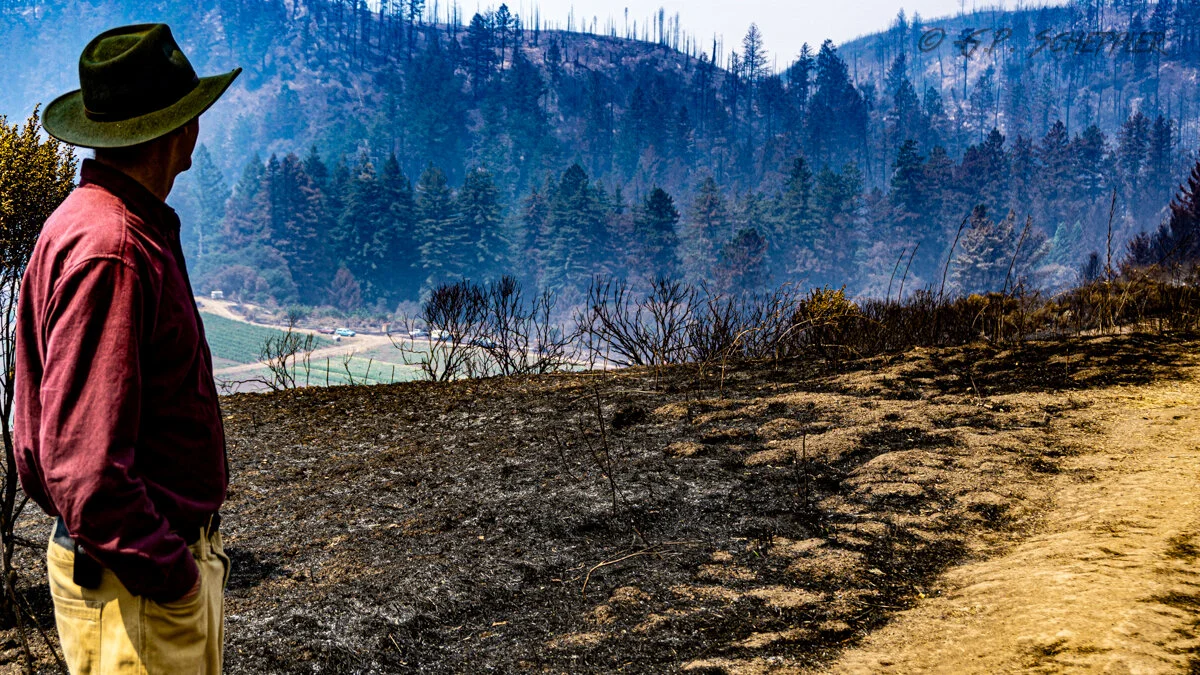
(1) Dr. Grey Hayes over looks the Molino Creek Farm and green valley from a burnt out field.
Davenport - Up in the hills above Davenport, two hippies stood tall against a wild ring of fire, well beyond the reach of rescue, to keep their farm’s dream alive. After three consecutive days battling to protect the Molino Creek Farm, Dr. Grey Hayes made the hazardous trip down Warrenella Road in pursuit of smoke-free air to celebrate his birthday while Bob Frank continued snuffing out spot fires to preserve the remaining farmstead. They had been cut off since Wednesday evening, locked in a pitched battle against the CZU Lighting Complex Fire to save the houses of their partners in lieu of any fire service.
Some of the homes they fought for still stood, others lay in ruin.
“In California right now,” says Dr. Hayes. “The color of money is black.”
As with any battle, no one gets out unscathed.
And I, dear readers, somehow found myself in a position to hear the tale first.
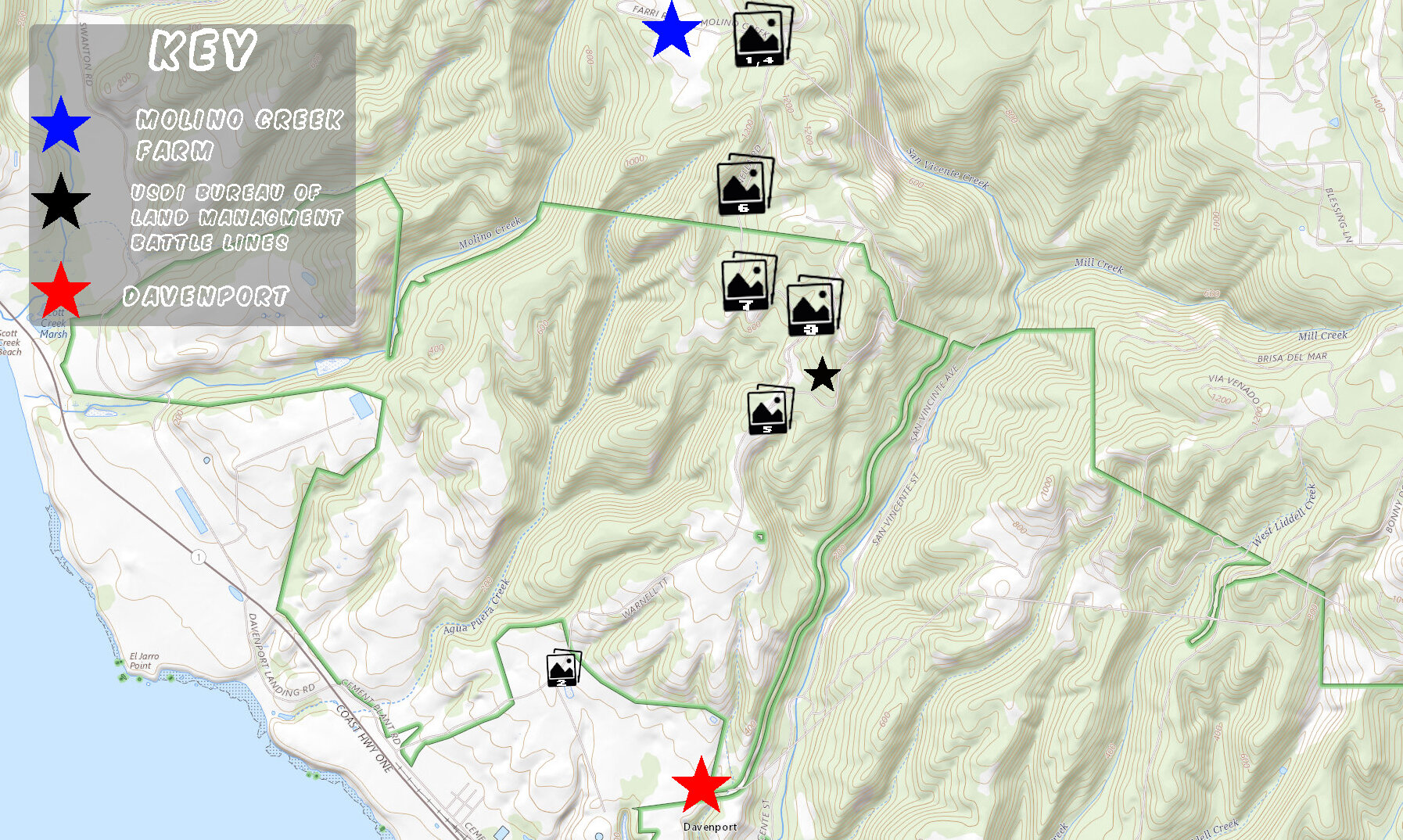
(2) The Molino Creek Farming Collective is located below the furthest visible ridge, two miles past the battle lines drawn by firefighting efforts.
Fire On Mountain
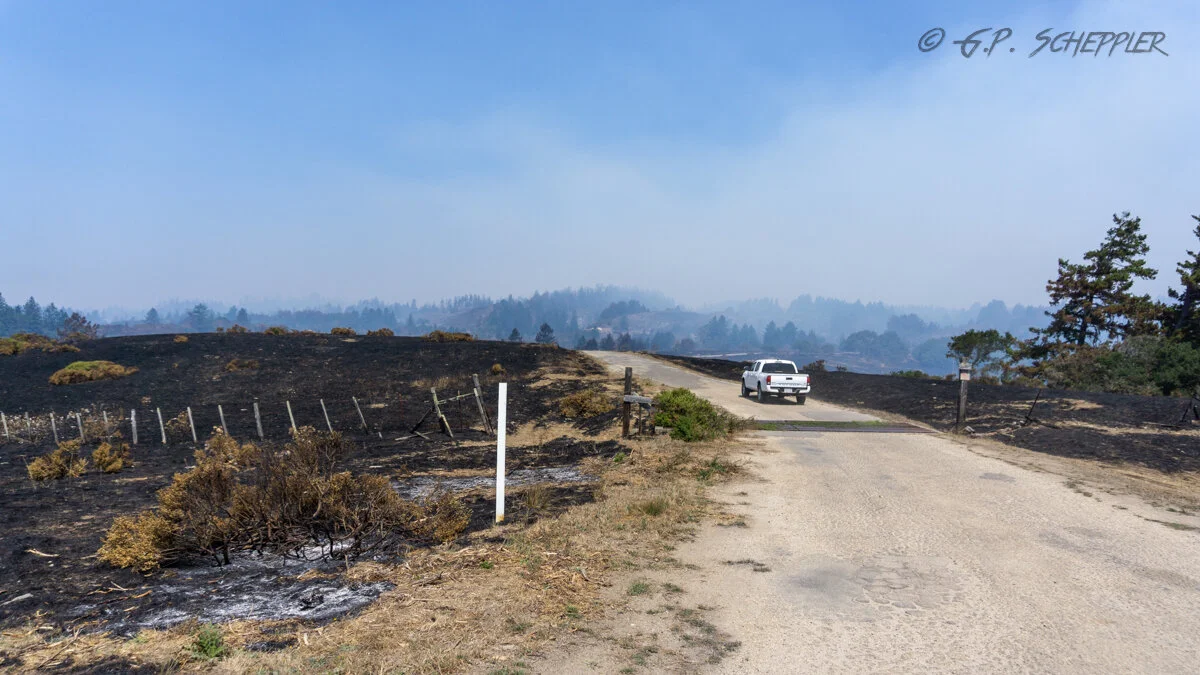
The makeshift convoy of 4wd Toyotas came to an abrupt halt at a sharp downward left in the rubble road. Having just raced up a steep loose rock trail through the still-smoldering carcass of a forest, over hill and burnt-out dale, I struggled to get oriented as my peripheral vision pulsed.
Ahead of me, a clean-shaven Dr. Hayes calmly emerged from a remarkably spotless white mid-size pickup and donned his cap with steady calloused hands.
“Up around the corner is where it starts to get sketchy,” he said with a smile.
Who the hell is this guy? I wondered. About 30 yards ahead a massive old-growth Douglas Fir wisped smoke from around its chalky base overlooking the road. Beyond, in a developed valley lay the world-famous Molino Creek Farm, producers of organic dry-farmed tomatoes popularized by the Grateful Dead. A green scar etched into the valley of ash.
“We honestly don’t know if or when (the tree) is coming down,” said Dr. Hayes. “But I wanted to stop and let you choose if we risk it. If we do go, we really have to gun it and go one at a time.”
Looming hundreds of feet above, the ancient lifeform watched us as it rocked with unfelt gusts of wind. Considering the luck already expended getting there, the decision to conduct the interview from the safety of a burnout field overlooking the commune was an easy one.
Moving through the pocked landscape with the ease of a person who has spent a lifetime teaching in the field, Dr. Grey took me step-by-step through the 72-hour battle. The scholarly doctor, who at one time advised the Sierra Club, taught undergraduates at UC Santa Cruz and currently works as the Education and Research Coordinator for Cal Poly at Swanton Pacific Ranch. A far cry from the wilderness smoke eater that stood before me, at least one would imagine.
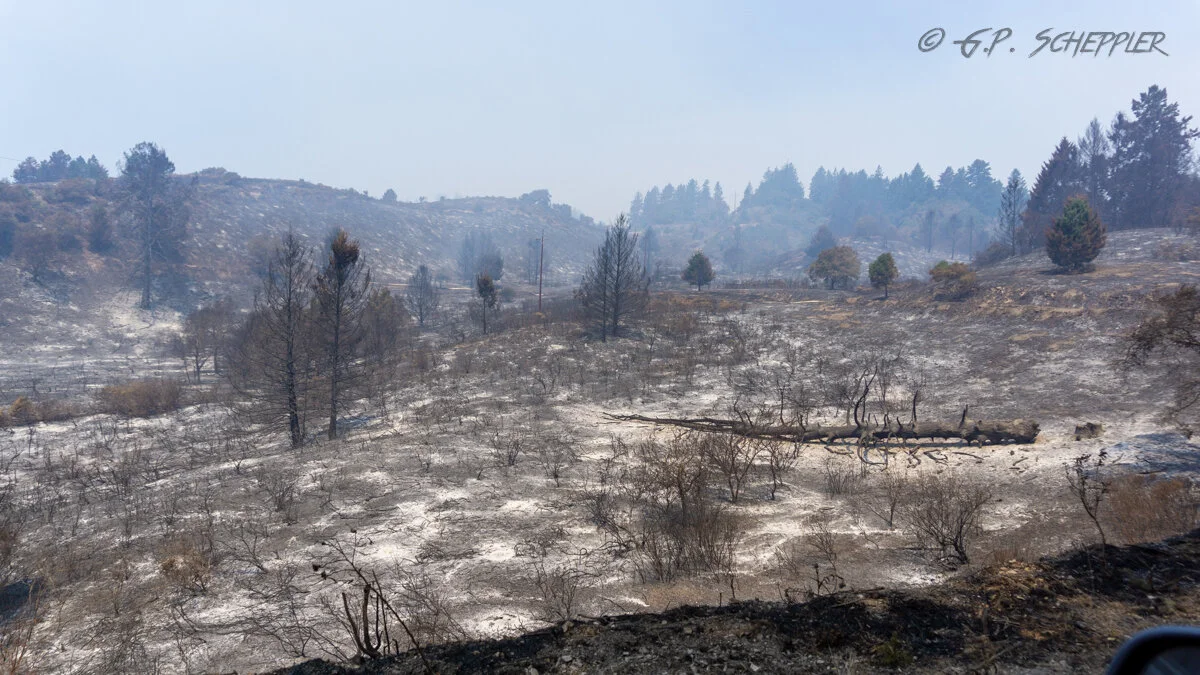
(3) The moonscape between the farming collective and firefighting battle lines.
In some remote stretches of the United States, the Wild West is still very much alive.
The desire to live off the grid and carve out a home beyond society’s protective services isn’t for everybody.
The M.C.F. Fire Department, aka Dr. Hayes and Mr. Frank, gave the United States Department of the Interior’s Bureau of Land Management Battalion Fire Chief Michael D. Chiodini a tour to assess the survivability of their property in the twilight of Wednesday. It was the last time a professional firefighter would set foot on the property until the firestorm had passed.
Armed with McLeod rakes, fire hoses, water pumps, and Nomex jackets the two frontiersmen planned to defend fighting positions established in the days prior with the help of ten other commune members.
Listening to Chief Chiodini’s recollection of their situation set my mind racing trying to picture the stone-faced badasses two miles down the road from where the inter-agency Hot Shots were cutting and burning battle lines.
“They have resources and a plan to defend their property, and seem pretty experienced,” said Chiodini. “We are not here to force people off their land. We inform them of the level of support we can provide if any. They have a right to protect what they’ve built as everyone else does.”
In the event that the duo’s defense buckled under the weight of the firestorm, the evacuation plan was to run out into the tilled field where the fire couldn’t pursue them. To hope the fire ran out of fuel before they ran out of supplies or the ability to resist the smoke & heat.
Tilled soil is to fire as salt to a banana slug, after all.
I held out little hope for those poor souls down the road.
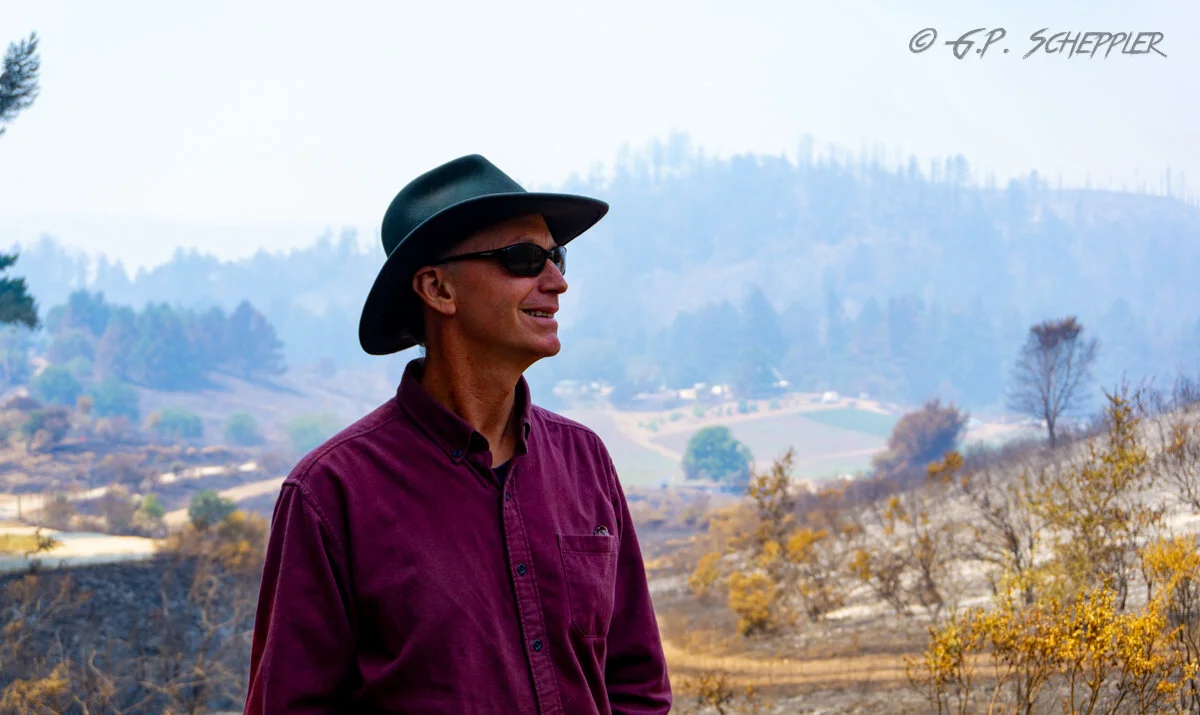
(4) Dos Equis needs to call Dr Grey Hayes, stat.
TOUCH OF GREY
Battles produce trauma, as an orange produces juice. You can see it plain as day in Dr. Grey’s eyes when he recounts clearing dead grass from bases of plastic above-ground water tanks.
“It seemed like that took longer than anything,” said Dr. Hayes. “It all had to be done by hand and we couldn’t use machines. The whole time knowing the fire is getting closer and closer. It wasn’t until that moment that it became clear just how critical protecting the tanks was going to be to save the farm.”
On the first night, the Douglas Fur erupted into a towering pillar of flame above Dr. Grey’s house, and he spent much of the night battling to keep the flames at bay. When he finally got a chance to rest in the wee hours of the morning, the rims of the valley around him were ablaze.
The scene was more than enough to drive anyone mad.
Fortunately for the collective, Dr. Hayes has a wealth of wilderness firefighting experience from his career as a conservationist and homesteader. The years spent working with firefighters on prescribed burns matched with his experience in 2009 protecting the farm from the Lockheed Fire to buoy the PhD as the Gates of Hell opened up around him.
“It is the only reason my intellect allowed me to stay and defend my home,” says Hayes. “Because it was terrifying. The Lockheed Fire was slow-moving, this fire...I could hear it coming, and when I saw it coming it was fast-moving across our property and all around us.”
His face is reminiscent of a sailor who talks about close brushes with the Reaper.
Memories so bright they scald, even in dreams.
Who knows what he saw in the flames or what went through his mind when he was forced to drop to his knees to find breathable air?
I did not ask, perhaps that makes me a bad journalist.
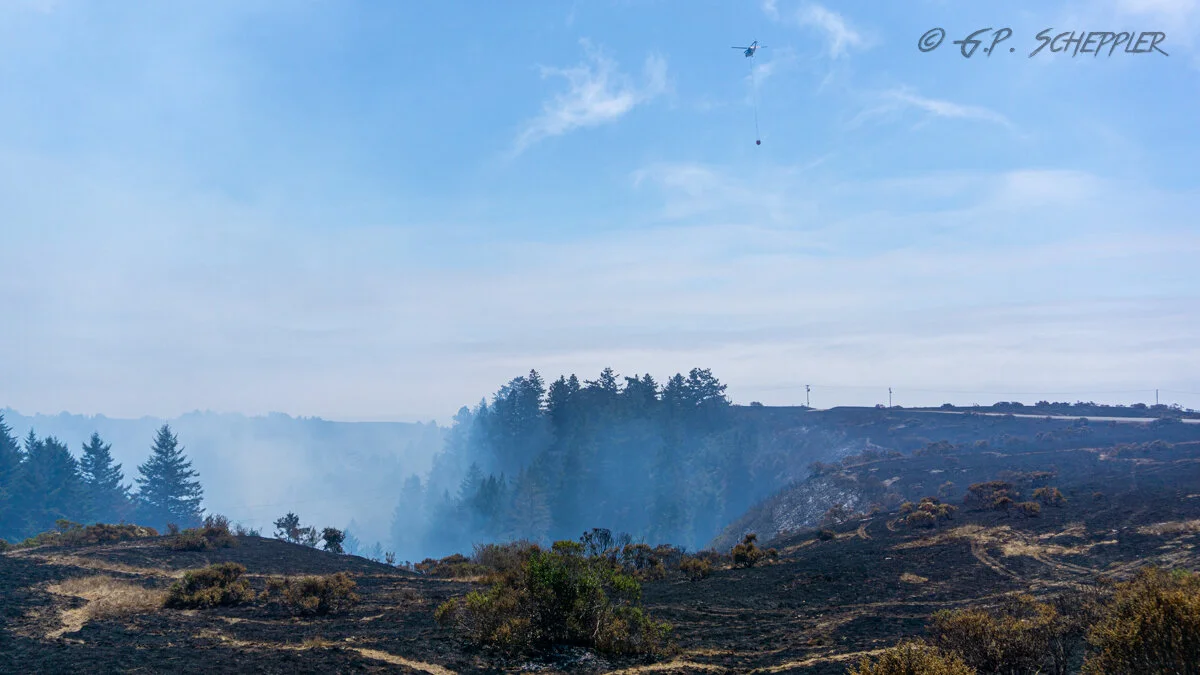
(5) The USDI’s BLM deployed personnel, equipment, and vehicles in the defense of the community of Davenport, but for the remotest of frontier farms like Molino Creek such protections were unavailable.
RIPPLE
Under normal conditions, the Molino Creek Farm is remote, in the middle of a Complex fire accessing it became downright hazardous.
After facing his second firestorm since the turn of the millennium, Dr. Grey and his neighbors' commitment to rebuild is unwavering.
“I love this area, I am going to stay,” says Dr. Hayes. “What it helps to do is convince more of my community about the amount of work it takes to be in this area safely. That means addressing fire hazards as they arise, not just circling a date on a calendar and waiting until it arrives. We are also going to place some metal tanks on this ridge over here...”
Ever the educator, Dr. Hayes is already hard at work making sure the collective builds back stronger and with the lesson of the past in mind.
The hippie and the GWOT veteran smiled and laughed at the madness of danger together, bonding over shared experience, more alike then different in our refractory period. You never feel quite so alive as you do after cheating the Reaper. Life beyond the battle lines isn’t for everybody, but it sure was for us.
It was time to go.
“Make sure you don't slow down or stop once we get under the canopy,” says Dr. Grey.
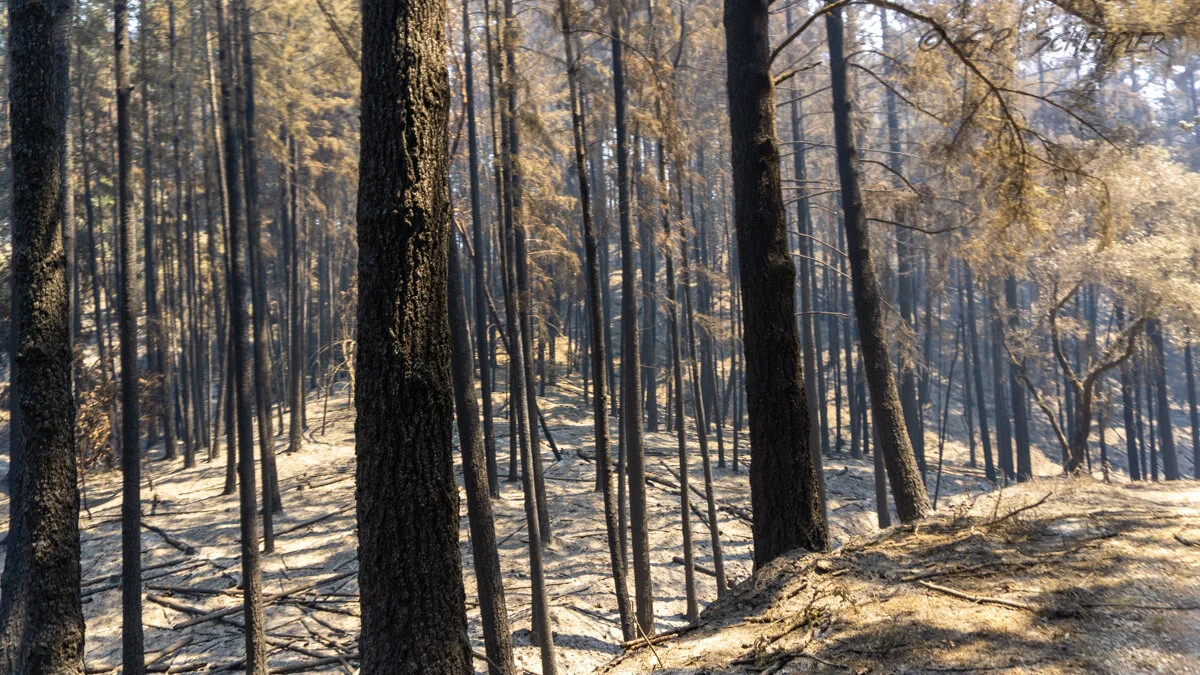
(6) Taken at full speed on our breakneck sprint out through a still smoldering forest
In the weeks since the fire moved past, the Molino Creek Farm and its residents have done their best to start rebuilding in the middle of a crisis zone and residents have started coming home. They have raised almost $70,000 on their GoFund Me page with over 473 contributors, organized by Mark Lipson, towards their efforts and on September 11th the Douglas Fur that threatened to cut off the valley came down with a little help from Cal Fire and the USDI’s BLM.
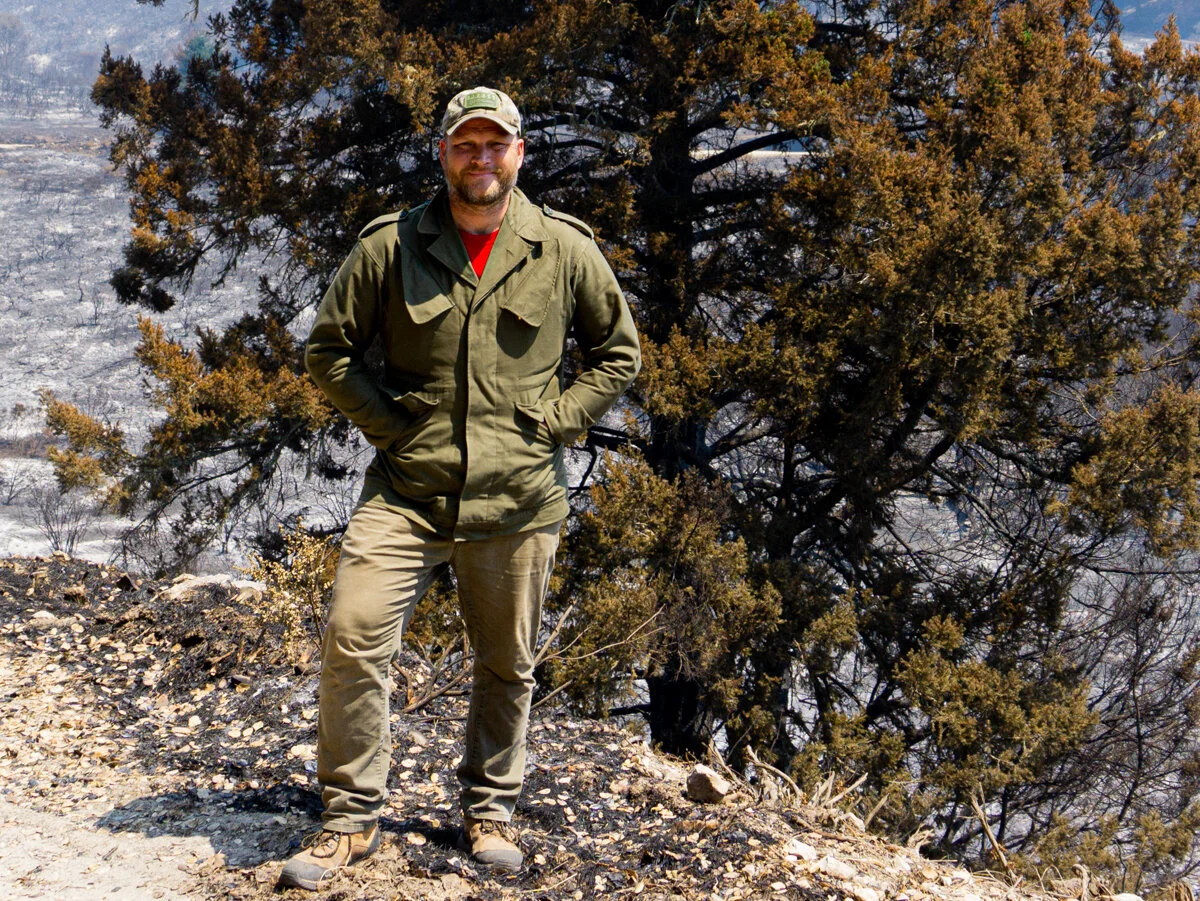
(7) Your trusty narrator, photographer, and crisis zone correspondent.